
Circumstances were unusual as the story of the 1927 Florence bank robbery unfolded. It occurred at the Lane County State and Savings Bank which opened in 1909, providing welcomed services for the growing community of Florence.
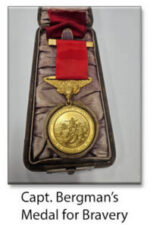
Among the bank’s officers, was its Vice President, Captain John Bergman, a highly respected businessman and Florence resident. He was also known for having been awarded a gold medal for bravery. In 1883, he was instrumental in helping to save 18 lives during a shipwreck of the steamer Tacoma, near the mouth of the Umpqua river.
The Captain’s son, John W. was also employed at the bank as the cashier. He later succeeded his father in becoming the bank’s President, and continued to successfully operate the bank in the ensuing years. After John W.’s sudden passing in 1922, his brother Henry, who lived in Florence with his wife and family, became President. With Henry’s business background folks remained satisfied with the bank’s services.
LOCKED IN THE VAULT
On the afternoon of January 27, 1927, the bank’s cashier, twenty-six-year-old Harriet Weatherson, reported to authorities that an armed, lone bandit held up the bank and locked her in the vault. As can be expected, Ms. Weatherson, who had been the bank’s cashier for 7 years, was quite distraught.
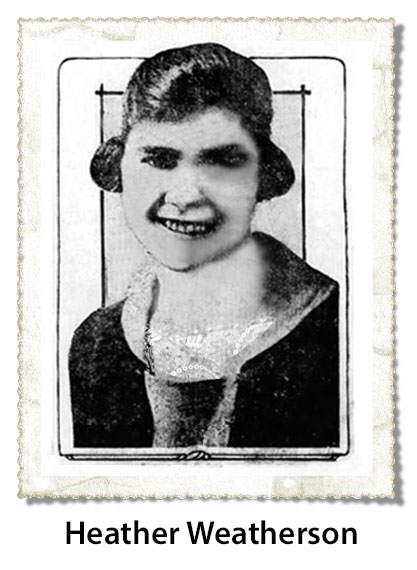
It was an era when in this small, unassuming town, the bank had not yet acquired what would be considered a sophisticated alarm system. According to Ms. Weatherson, the bandit forced her into the vault where she remained captive for 1.5 hours. Frantic and desperate, she claimed to have utilized a broken screwdriver found on the floor of the vault to manipulate the lock until she was eventually able to remove a bolt to free herself.
On the day of the incident, the 38 year-old bank President Henry L. Bergman, was in Portland attending a conference. Upon learning of the robbery, Mr. Bergman immediately returned to Florence. Shortly after his arrival, he determined the bank had been robbed of $13,000 in cash and $7,000 in travelers’ checks.
Authorities questioned Ms. Weatherson and found the details in her story of being “face to face” with the alleged robber, locked in the vault then escaping, to be suspicious. The Burns private detective agency was called in to examine the vault and determined the bolt had “never been touched, as the varnish had not been broken”. Lane County Sheriff Frank Taylor was consulted and also agreed the circumstances seemed unlikely, at best.
Henry Bergman and Ms. Weatherson appeared in Eugene the next day and met with county officials to answer further inquiries regarding the incident. They also spoke with Sheriff Taylor who informed them that he may have captured the suspect. Ms. Weatherson was asked to view the suspect and determine if he was indeed the robber who allegedly confronted her. The Sheriff showed her a hobo who unbeknownst to her had been apprehended for an unrelated incident. To Sheriff Taylor’s surprise, upon seeing the suspect, she immediately stated, “that’s him”.
Following the meeting, Bergman and Weatherson stated they needed to attend a meeting with a bank examiner. They were excused but instead, the couple chose to flee. On Monday, January 31 Bergman borrowed a friend’s car in Eugene. They were traced to Fresno, CA, where they spent the night. They abandoned the car, took a train to Los Angeles, then boarded another train to Safford, Arizona. In Arizona they became aware they were being sought by authorities, and prepared to leave Safford. In their haste, Bergman wrote a letter to the Safford postmaster with instructions for his mail be forwarded to Longview, Texas. Bergman then sent a second letter to the Longview postmaster with instructions that his mail be forwarded to Birmingham, Alabama. On February 2 a warrant was issued in Oregon for both Bergman and Weatherson.
In the following days, the couple mailed letters to family and a friend. Bergman wrote a friend in Eugene and Weatherson wrote letters to her mother and sister in Florence. She expressed regret at having caused her current predicament. The letters were turned over to the District Attorney’s office, allowing authorities to follow the couple’s route. They were arrested when Bergman attempted to retrieve his mail in Birmingham on February 19. Once captured, Henry stated, “we came down here to Birmingham to start life all over again.” In the end, the couple’s entire time eluding capture was 19 days, with their correspondence by mail resulting in their apprehension. While detained, Weatherson received a comforting letter from her mother stating, “her family was determined to stand by her”.
Shortly thereafter, a portion of the money from the robbery was turned in by the bank’s Vice-President, Carl Bergman (Henry’s brother). $5,000 was unaccounted for. As it turned out, Henry Bergman had telephoned his wife in Florence and informed her where the money was hidden.
On March 8 Henry Bergman appeared for his arraignment in Eugene. On March 12, he entered a plea of guilty and was sentenced by the Circuit Court to 1) a maximum of 10 years for embezzlement, and 2) a maximum 3 years on charges of making loans while the bank’s reserves were deficient. The Court further ordered that his sentences were not to be run concurrently. He was sent to the Oregon State Penitentiary in Salem on March 14, and assigned to be in charge of the prison commissary.
In a statement from the penitentiary to Weatherson’s attorney, Bergman declared “I alone am responsible for the defamation of the bank. Harriet Weatherson never received one cent of benefit in any way . . . . Whatever she has done was without thought of gain or benefit to herself.” It was further revealed that throughout her career with the bank, Ms. Weatherson had invested most of her earnings into timber companies under advice from Bergman.
At her indictment on March 10, Harriet Weatherson entered a not guilty plea to the charges. It is said she displayed no emotion during her court appearance. Bail was set at $20,000. Her mother, sister, and uncle George C. Knowles (mayor of Cottage Grove) posted the bond for her release. Ms. Weatherson returned to court 8 days later and changed her plea to guilty for the charge of embezzlement of bank funds and not guilty to the charge of authorizing illegal loans. She was sentenced to 6 years and taken to the state penitentiary in Salem that afternoon. While incarcerated, she was assigned to manage the accounts of the flax industry. After serving 2 years, she was paroled on March 27, 1929.
Although it could be said justice was served and the case should have ended there, it was not forgotten by those involved.
In 1929, about 50 citizens from Lane County including ex-Sheriff Taylor and former State Senator J. Magladry, presented a petition and letters to then Governor Patterson urging a pardon for Henry Bergman. At the time, Bergman had 2 more years to serve on his 13-year sentence in order to be eligible for parole. According to Oregon law, his embezzlement conviction meant parole eligibility was allowed only after half of his sentence was served, although other time deductions were considered based on good behavior.
Prison Superintendent Henry Meyers described Bergman’s and Weatherspoon’s incarceration as: ”they [both] were the best help in those two departments that the prison ever had.” Perhaps due to her earlier courses as a freshman in the school of commerce at the Agricultural College in Corvallis, Mr. Meyers claimed Miss Weatherspoon was “the most valuable inmate of the state prison”. In addition, Mr. Meyers sent a letter to the Governor stating that “during his 3 years and 4 months of incarceration, Henry Bergman was instrumental in saving the state thousands of dollars through installation of a new accounting system at the institution. His conduct has been exemplary”.
On July 3, 1930, Governor Norblad, (who succeeded Governor Patterson) granted a commutation of Bergman’s sentence at the recommendations of: Judge Skipworth, who had originally sentenced Bergman; John Medley, who prosecuted Bergman; 75% of the bank’s depositors; and Henry Meyers, Superintendent of the penitentiary. In his letter, Judge Skipworth stated that at the time of his 1927 sentencing, “it was thought the bank was a ‘complete and total loss’. Subsequent events have developed that the bank will, under the circumstances pay the depositors quite well . . . I am now informed that the savings department will pay 80% and that the commercial department will pay 92%”. In the end, Governor Norblad granted a commutation reducing Henry Bergman’s prison term to five years, and with good time credits, reduced it further to three years and four months. Bergman was ultimately released in 1930.
During his incarceration, Henry’s first marriage resulted in a divorce. On January 21,1942 Henry Ludwig Bergman and Harriet Almena Weatherson were married in Clay, Florida. Records show that in 1951, the couple lived adjacent to Henry’s brother, Carl Bergman and his wife in Daytona Beach, Florida.
The Lane County State and Savings Bank closed on Feb 2, 1927 following the January robbery incident. Florence was without banking services until Lane County Bank opened in January, 1947.
* * * * *
Story by Deb Lobey
OralHistory@spmuseum.org
Sources
“Arrest of 2 Bank Officials Sought.” The Register Guard. 2 Feb 1927, p. 1.
“Banker, in Prison has Sentence Cut.” Satesman Journal (Salem, Oregon). 4 July 1930, p. 1.
“Bergman and His Cashier are Taken.” The Register Guard. 20 Feb 1927, p. 1.
“Berman is Sentenced in Circuit Court.” The Eugene Guard. 12 Mar 1927, p 1
“Discrepancies are Found in Bank Records.” The Eugene Guard. 5 Feb 1927, p. 1
“Governor Commutes Bergman’s Sentence; Release Comes Soon.” Daily Capital Journal (Salem, Oregon). 3 July 1930, p. 1.
“Henry Bergman To Get Early Release.” Siuslaw Oar. Feb 11 1930.
Image of H. Weatherson. The Eugene Guard. 19 Feb 1927, p. 1.
“Miss Weatherson Sentenced to Pen.” Morning Register. 19 Mar 1927, p. 3.
“Prisoner is Valuable.” The Eugene Guard. 28 Jun 1927, p. 7.
“Woman is Paroled.” The Bend Bulletin. 27 Mar 1929, p. 8.