


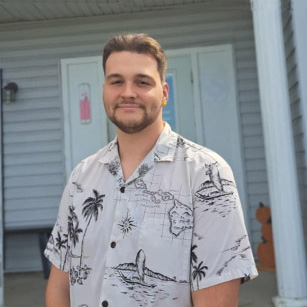
 Fast forward to September, 2024 when scuba diver Lawrence Bloomfield visited the Museum’s Kyle Research Library to donate items from his remarkable experience with the Tahkenitch Lake derailment project. For some time he had been encouraged by others to conduct an exploratory dive of the lake for possible derailment artifacts. He entertained the idea, and began researching the possibility of such an undertaking. Because the Tahkenitch boat dock was unserviceable at the time, he studied the area to determine a feasible entry point from land for the dive. With about 500 pounds of gear needed for the dive, sorting out the logistics was an essential element of his planning process.

A HISTORIC EXPEDITION
Seven months after obtaining the CTSI permission, Lawrence and Thaxter took their first dive. According to Lawrence, visibility in the lake was poor. The lake’s algae, mud, silt, and clay complicated the prospect of seeing, much less recovering artifacts. Despite a depth of only 22 feet and using guarded movements to minimize stirring up the silt, they could barely see more than 3 inches in front of them. Flashlights were nearly useless. They resorted to using their hands to feel along the lake’s silt covered floor. Within 15 minutes of the dive they resurfaced to evaluate the benefit of continuing. Considering the research, travel and invested efforts over the past 2 years, Lawrence suggested they give it another 15 minutes to decide if the project could still be salvaged. They continued the dive, and quickly lost sight of each other. At one point, Lawrence reached out to what he thought was Thaxter’s fin. To his surprise, he grabbed onto what appeared to be a bag. When they resurfaced, Lawrence lifted the bag and relayed to Thaxter: “inside of this is a piece of the train”. By the end of the four-hour dive, they recovered more than 300 parts from the derailment. According to Lawrence, perhaps the most rewarding item recovered was a half-buried portion of a rail beam. After resurfacing from the dive, he recalls a satisfying moment when he declared to the crew: “I don’t think we found the icing on the cake – we found the cake itself!” After inspecting the track’s rail piece, Lawrence suggests it may well be the piece that caused the train to derail and ultimately tip over. Click to enlarge image.


Many thanks to Lawrence Bloomfield, Thaxter Haywood, and the crew for donating many of the derailment artifacts to the Siuslaw Pioneer Museum. The artifacts include the rail beam, bolts, spring, and brake pad – all of which are displayed in our second floor exhibit area. The Museum is open to the public Wednesday through Sunday, noon to 4 p.m. The on-site Kyle Research Library is open Tuesdays and Thursdays, 11 a.m. to 3 p.m.
Lawrence Alexander Bloomfield – Engineer, Diver, and Owner of The Deep Dive LLC
Thaxter Haywood – Professional Photographer and Diver
Roen Khufu – Surface-to-vessel artifact transfer specialist and Arborist Crew Member
Jira Jarman – Captain
Larry Bloomfield – Lawrence’s Father, Radio Station Programmer, and Arborist Crew Member
Katelin Bloomfield – Lawrence’s Wife, Financial Specialist
Kaleb Haggard – Arborist Crew Member
Axel Bloomfield – Regulatory Oversight Specialist, and Governance and Risk Analyst
______________
SOURCES:
“7 Suspended in Train Derailment”. The Oregonian; 9 Jul 1987: 23.Sources:
Calder, Bill. “Rail Crew of 8 Fired After Derailment”. The Oregonian, 7 Aug 1987: C6.
Koberstein, Paul and Calder, Bill. “Derailment Sinks Cars, Starts Fire. The Oregonian; 27 Jun 1987: 20.
Little, Kristy. Eyewitness News Report; “Southern Pacific Tahkenitch Lake Train Wreck, Train Falls Into Lake”; YouTube
Serra, Bob. “Human Error Blamed in Derailment”. The Siuslaw News, 8 July 1987; Vol 27.
“Trains Moving Again”. The World; 7 July 1987: 1.
-
- * * * * *
- Story by Deb Lobey
- Transcript by Suzanne Korosec
- oralhistory@spmuseum.org