
Among the many cultural gifts brought by early migration to America was music – including hymns, psalms and folk songs. Research shows what became known as barbershop harmony, likely originated from the influences of the African-American culture during the 1870’s.
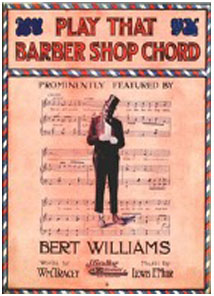
This style of singing was often heard by those working in plantation fields. The 1910 song “Play that Barbershop Chord” is said to have been among the first written music using the term “barbershop” when referring to its melodic, special style of harmony. The harmony itself is unique, born from songs sung in four parts.
The unaccompanied male voices of a Barbershop quartet are comprised of the lead voice who most often carries the melody. He is accompanied by a tenor harmonizing above him. The bass singer provides the lowest harmonizing notes, with the baritone voice contributing the in-between notes, (above or below the lead). Together, the resulting chords are sung in a sound pleasant to the ear, with easily understood lyrics that often bring a smile and a bit of toe tapping to the listener.
THE BARBERSHOP CONNECTION
Many of the early quartet gatherings began in neighborhood barbershops. Historian and quartet member James Weldon Johnson, in 1929 claimed “every barbershop seemed to have its own quartet.” He asserted that at one time, large resort hotels had singing waiters performing in quartets. Although initially considered ‘unsophisticated’ music, Barbershop harmony later gave rise to minstrel, vaudeville and ragtime. It was an era when young boys in quartets sang for coins on street corners, and railway stations. Some went on to become jazz musicians. Such was the case for Louis Armstrong, who was a quartet member and regularly sang for tips on the street in New Orleans. In 1912 on New Year’s Eve, his quartet had been singing and collecting pennies on a street corner. It is said Louis fired a gun in the air and was arrested. He spent the next year and a half in a reformatory Home for Boys. The sentence proved to be a blessing for Louis. The Home had a band, and it was there he learned to play the cornet. Upon his release in June of 1914 he resumed his quartet role. Many years later he attributed his quartet experience as having been a significant influence for his musical success. He claimed “singing was more in my blood than the trumpet.”
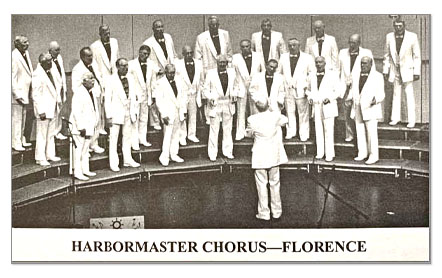
FLORENCE HARBORMASTER CHORUS
Formed in 1999, the Florence Harbormasters became a chapter of the Barbershop Harmony Society, a large national organization. As a non-profit organization, the Harbormasters performed benefit shows in Yachats, Eugene, Florence, Salem, Mapleton, Reedsport, and Newport. Profits from performances were dedicated to chorus expenses, charity, and educational purposes to promote and support vocal music, such as the Siuslaw school’s vocal music programs. The Harbormaster Barbershop Chorus shows were consistently performed to sold out audiences.
Local resident Bob Weber recalls his initial exposure to Barbershop harmony occurred in 2010, while coincidentally in a barbershop. By chance, he and another waiting customer struck up a friendly conversation. During their chat, the topic drifted to music. Bob was asked whether he enjoyed music and specifically, singing. Responding he enjoyed music of all kinds, Bob mentioned he had sung in his high school chorus, then in college.

VALENTINE SERENADES
Traditionally, the Valentine’s Day holiday is a busy time of year for most Barbershop quartets. It was the same for the Harbormasters Quartet. According to Bob, each year, between the days of February 12 – 14, they would receive many requests for ‘sweetheart’ serenade visits. The quartet would arrive for a visit (most often a ‘surprise’) at the home, work place, or other address to perform a repertoire of songs, along with a delivery of flowers or candy. This proved to be a popular fund raiser for the chorus.
The Harbormasters Barbershop Chorus was comprised of male vocals only. In 2001, the Florence Nightingale Quartet, featuring women’s Barbershop harmony was established. They frequently performed at events in town, often in the same shows as the Harbormasters.
Following the Florence production of Oklahoma, the popularity of the Barbershop Harmony Chorus grew to 25 members, allowing for the formation of several quartets within the chorus. They rehearsed weekly and performed for 20 years. However, due to the demands of rehearsals, personal careers and family life, membership declined. Sadly, the chorus is no longer currently active.
- * * * * *
- Story by Deb Lobey
- oralhistory@spmuseum.org
Sources
- “A Rich-African American Tradition”. Barbershop Harmony Society. 2026.
- Abbott, Lynn. “Play That Barber Shop Chord: A Case for the African-American Origin of Barbershop Harmony” American Music. Fall, 1992 pp. 289-326.
- “Barbershop Harmony: The Timeless Tradition of Quartet Singing”. You Tube, uploaded by Wessel the Camper, Jun 25, 2024.
- Image. The Harmonier. July/August 2001. pp. 13 – 17.
- Johnson, James Weldon. “African Americans and Barbershop Harmony”.
- “The Origin of the Barbershop Chord”.
Play that Barbershop Chord: The Historical Roots of Barbershop Harmony. - Sparks, Wilbur. “Play that Barbershop Chord”. The Harmonizer. January/February 1994.
- “The Origins of Barbershop Harmony”; “Definition of the Barbershop Style”. Annual Barbershop Harmony Program. August 2005 pp. 7, 14, 26.
- Wright, David. “The African-American Origins of Barbershop Music and Why It Matters”.
- Wright, David. “African Americans and Barbershop Harmony”. Timeline of African American Music.